




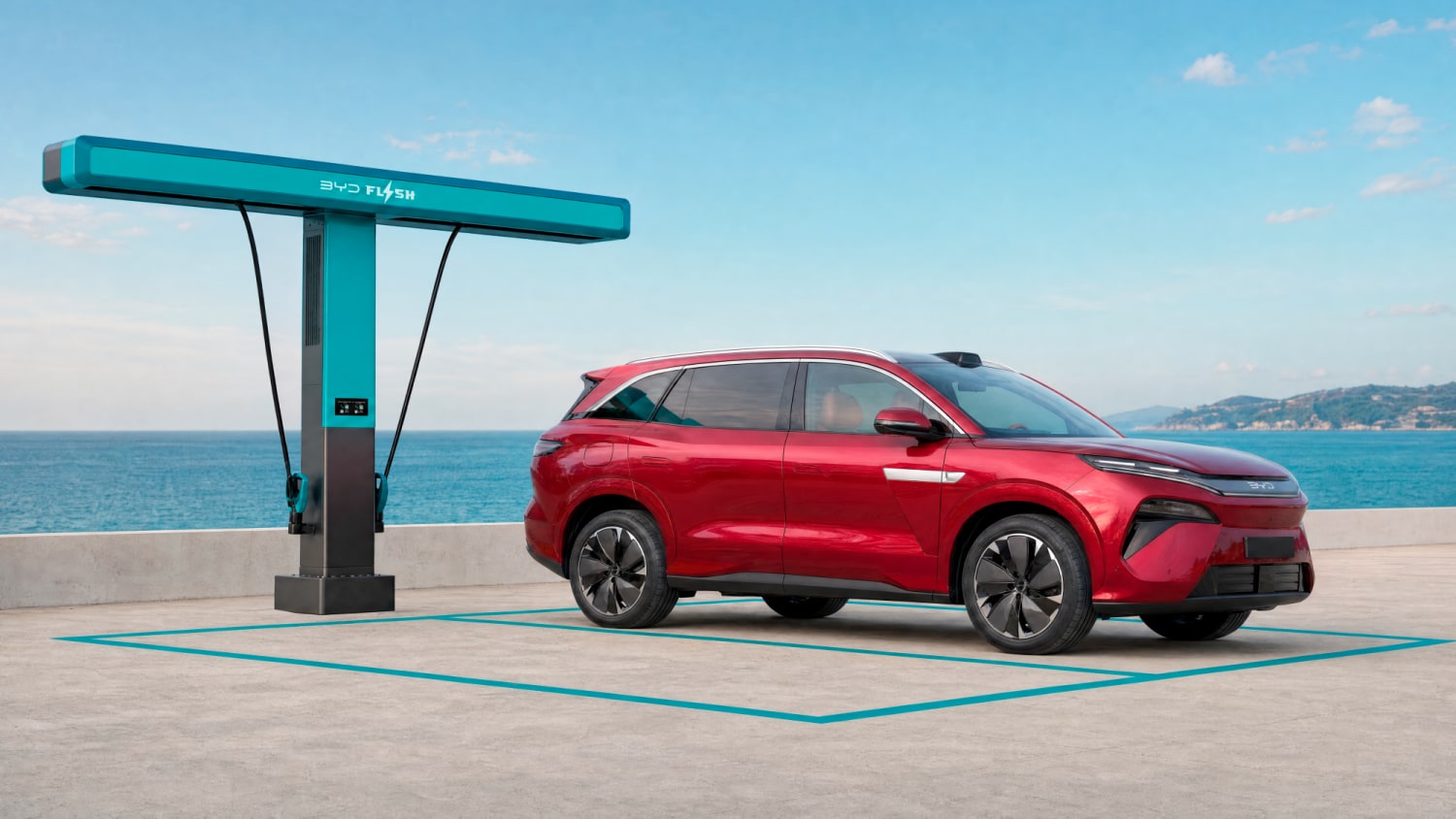

BYD’s headline charging figure for the European ATTO 8 is specific but easy to overread: the company describes a 10–97% battery refill in nine minutes. The statement concerns what the vehicle and a suitable charging system are claimed to achieve. It does not, on its own, establish that public chargers across Europe will be able to deliver the required power.
The claim is tied to a 115 kWh second-generation Blade Battery
According to BYD, the European ATTO 8 will use a 115 kWh second-generation Blade Battery. The Blade Battery is BYD’s name for its lithium iron phosphate (LFP) battery technology. The published capacity identifies the battery’s nominal energy storage, but the supplied announcement does not state a separate usable capacity figure, charging power curve or the exact test conditions behind the nine-minute result.
The charging window is also important. BYD specifies 10–97%, rather than a complete 0–100% cycle. That leaves the battery outside both the very low and very high ends of its state-of-charge range. Charging systems commonly reduce power as a battery approaches a high state of charge, so a stated window should not be treated as proof that every charging session will take nine minutes or that a full charge will do so.
Why the nine-minute figure cannot be converted into a public charging promise
A vehicle capability and charger availability are separate parts of the charging system. The car must be able to accept the claimed charging rate, while the charging site must provide the necessary power, connector compatibility and operating conditions. The supplied BYD material confirms the first part only as a manufacturer claim. It does not identify a European public-charger network, site count or rollout schedule capable of reproducing the result.
Temperature, battery state of charge, charging-site load and other operating conditions can affect the power delivered during a session. None of those conditions is provided in the announcement, so the nine-minute statement should be read as a claimed best-case or specified result rather than a guaranteed journey-time calculation. The announcement also does not provide an independent test of the figure.
Range and timing are separate specifications
BYD claims up to 653 km of combined WLTP range for the ATTO 8. WLTP is a European test cycle; it is not a promise of a fixed real-world distance, and it should not be compared directly with CLTC or EPA figures. Range and charging time describe different attributes: the 653 km figure concerns energy consumption over the WLTP procedure, while the nine-minute figure concerns a specified battery refill window.
BYD says the ATTO 8 is due to arrive in Europe in the first quarter of 2027. Until the company publishes detailed charging specifications and compatible infrastructure information for individual European markets, the nine-minute number remains a manufacturer claim about the vehicle system—not evidence that today’s public charging network can routinely deliver it.
Sources
- https://media.byd.com/byd-launches-atto-8-flagship-suv-with-flash-charging-at-paris-motor-show/?lang=eng&media=image&page_media=1
- https://www.techradar.com/vehicle-tech/hybrid-electric-vehicles/the-future-of-ev-charging-byd-reveals-worlds-first-station-that-combines-solar-robotic-charging-arms-and-5-minute-recharge-sessions
- https://www.wallpaper.com/transportation/yangwang-altior-and-u9-xtreme-launch-byd-abu-dhabi
Recommended Comments