




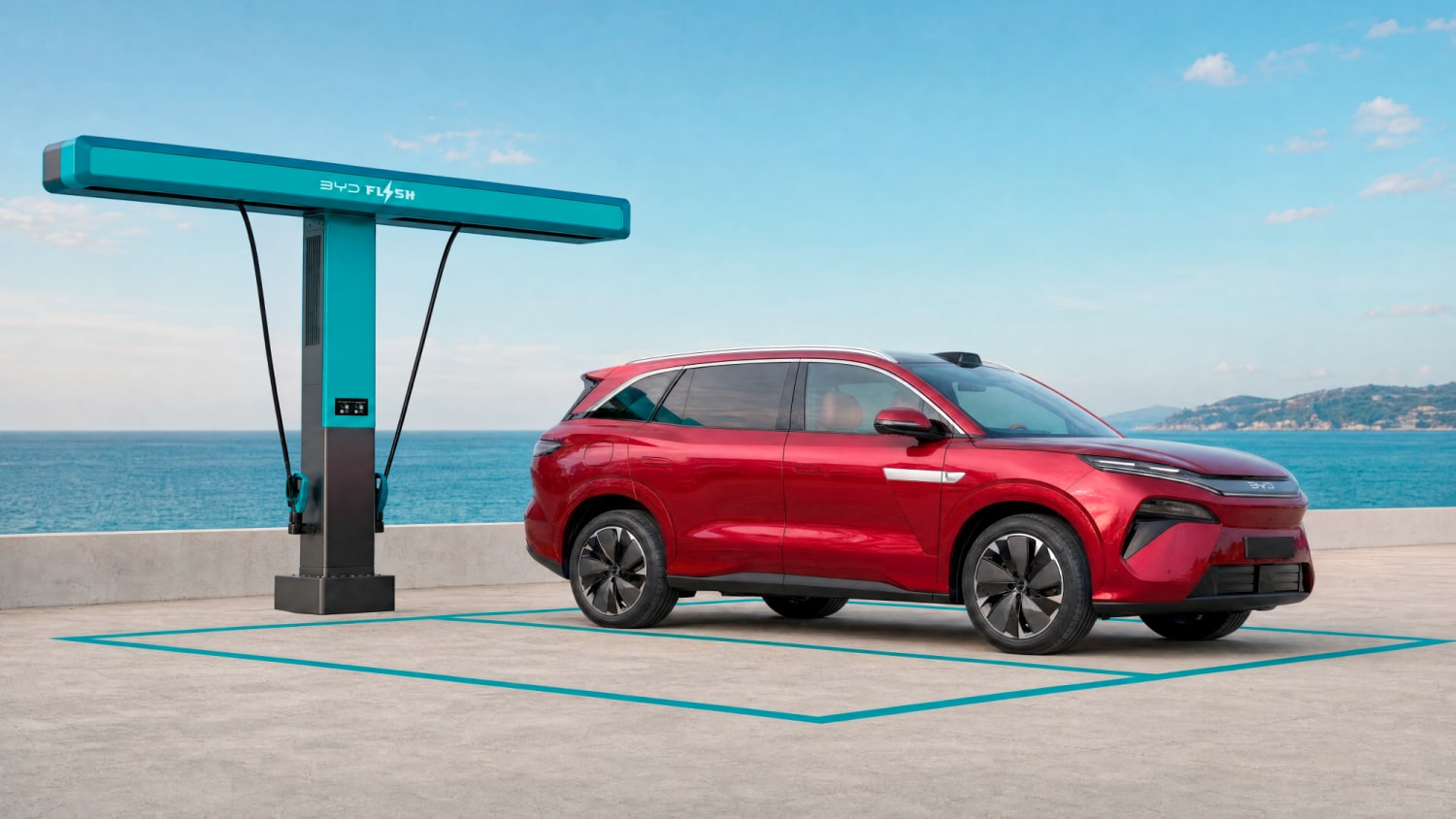

The main technical question around the BYD ATTO 8 is not simply how large its battery is, but how much of its advertised charging performance can be accessed in everyday conditions. BYD says the seven-seat SUV uses a 115 kWh second-generation Blade Battery and can accept a charge from 10% to 70% in five minutes using its FLASH Charging system. The company also quotes 10% to 97% in nine minutes.
Those are manufacturer claims for the vehicle and the charging system. They should not be read as a promise that every European charging station will deliver the same result. The charging time depends on using compatible FLASH Charging equipment with the required output. The supplied information does not specify the power rating of that equipment, nor does it establish how widely such chargers will be installed. Charger availability is therefore separate from the ATTO 8’s claimed technical capability.
A 115 kWh battery paired with a 653 km WLTP claim
The 115 kWh figure refers to the battery pack BYD says is fitted to the ATTO 8. BYD describes it as the second generation of its Blade Battery technology. Blade Battery is BYD’s name for its battery-pack design, while the supplied announcement identifies the ATTO 8 as the first second-generation Blade Battery model for Europe. The available material does not provide additional cell chemistry, pack voltage, charging-power or thermal-management specifications, so those details cannot be inferred from the battery name alone.
BYD quotes up to 653 km of combined WLTP range. WLTP is the standardized European test cycle; the figure is not an EPA or CLTC rating and should not be compared with results from those cycles as if they were equivalent. “Up to” also indicates that the quoted maximum applies under a specified version or test configuration. The provided information does not identify the exact equipment, wheel or drivetrain conditions behind the 653 km figure.
Two versions use the same battery pack
According to Autocar’s report, the European range is planned to include Design RWD and Excellence AWD versions, both using the same battery pack. RWD means rear-wheel drive, while AWD means all-wheel drive. The shared 115 kWh pack does not mean the two versions will necessarily have identical range or charging results: BYD’s supplied figures are headline claims, and the available facts do not state separate WLTP ratings or charging times for each drivetrain.
The distinction matters when interpreting the five-minute claim. A battery’s capacity describes how much energy it stores, while charging time describes how quickly energy can be transferred under suitable conditions. A compatible high-power charger, the vehicle’s charging limits and the charger’s ability to sustain its output are all relevant. None of the supplied specifications establishes that the 10–70% or 10–97% times will apply at ordinary European fast-charging sites.
European timing remains part of the specification
Autocar reports that European sales are due in the first quarter of 2027. That is a reported launch timetable, not confirmation of a current order opening, country-by-country pricing or identical availability across EU and UK markets. BYD’s announcement establishes the ATTO 8’s claimed battery and range figures, but the supplied information does not provide prices, warranty terms, final market specifications or a regional FLASH Charging network.
For now, the clearest technical description is therefore limited but significant: the ATTO 8 combines a claimed 115 kWh second-generation Blade Battery with up to 653 km of WLTP range, while its 10–70% five-minute and 10–97% nine-minute figures depend on the matching charging infrastructure. The missing detail is not the battery capacity, but the charger specification and market availability needed to reproduce those times.
Sources
Recommended Comments