




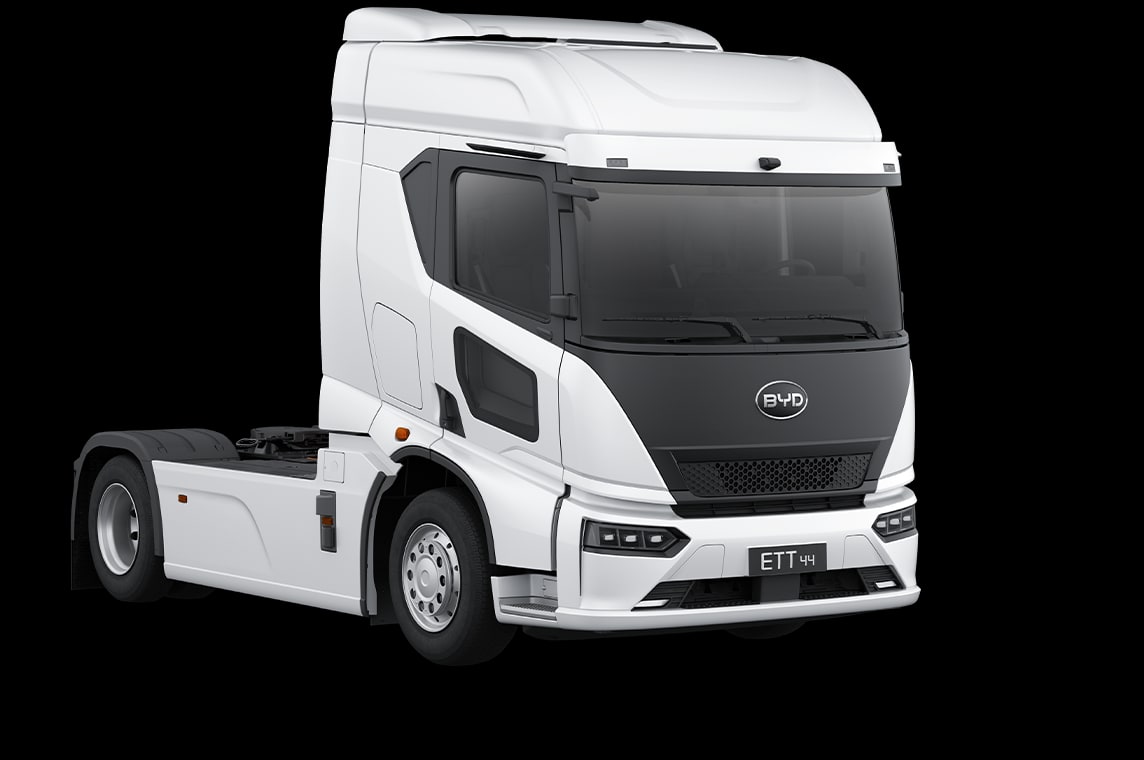

The BYD ETT 44 has received a five-star rating in Euro NCAP’s commercial-vehicle safety assessment, alongside the organisation’s CitySafe recognition. The headline result is strong, but the detailed scores show why the rating needs to be read as more than a single number: the electric truck performed particularly well in areas linked to driver awareness and visibility, while some collision-avoidance functions did not match the leading performers.
Euro NCAP awarded the ETT 44 a score of 89% for Safe Driving, 73% for Crash Avoidance and 80% for Post-Crash Safety. These are separate elements of the assessment, so the five-star result does not mean that every tested assistance function achieved the same level of performance. Instead, the breakdown points to a truck whose safety strengths are concentrated in visibility and the systems supporting everyday driving.
Low cab and e-mirrors support the truck’s direct vision
Euro NCAP highlighted the ETT 44’s low cab, lower door window and e-mirrors as important direct-vision strengths. Direct vision is especially relevant to commercial vehicles operating in built-up areas, where the driver’s ability to see nearby road users can complement electronic assistance systems.
The assessment therefore gives considerable weight to the truck’s physical design, not only to cameras, sensors or automated warnings. A lower cab and a lower window line can help the driver see more of the area close to the vehicle. Euro NCAP’s comments identify these features as part of the reason for the ETT 44’s strong performance in the Safe Driving category and its CitySafe recognition.
That distinction matters when interpreting the result. Direct vision is a built-in characteristic of the vehicle’s cab and mirror arrangement, whereas collision avoidance depends on how the truck’s assistance systems detect and respond to particular hazards. A strong result in one area does not remove the need to examine the other.
Collision avoidance remains the main qualification to the five-star result
Euro NCAP said the ETT 44’s frontal and lane-departure vehicle-to-vehicle avoidance performance trailed leading performers. The published assessment gives the truck 73% for Crash Avoidance, below its 89% Safe Driving score. The available results do not establish that the systems are ineffective; they show instead that performance was not class-leading in those specified situations.
This is the clearest gap in the assessment. The ETT 44 combines strong direct visibility with a less decisive result for certain electronic avoidance functions. For fleet operators, that makes the detailed category scores more informative than the five-star label alone, particularly when comparing vehicles intended for dense urban work.
The result also illustrates the limits of using a single safety rating as a complete description of a commercial vehicle. Euro NCAP’s detailed ETT 44 assessment records both the strengths and the weaker areas: 89% for Safe Driving, 73% for Crash Avoidance and 80% for Post-Crash Safety. Those figures should be considered together rather than treated as interchangeable measures.
On the evidence published by Euro NCAP, the ETT 44’s five stars are best understood as a strong overall result built substantially on direct vision and safe-driving performance. The remaining question is how its specific frontal and lane-departure vehicle-to-vehicle avoidance functions compare with other commercial vehicles in the same operating environment. The assessment identifies that gap, but the supplied results do not provide a broader model-by-model comparison.
Sources
Recommended Comments