




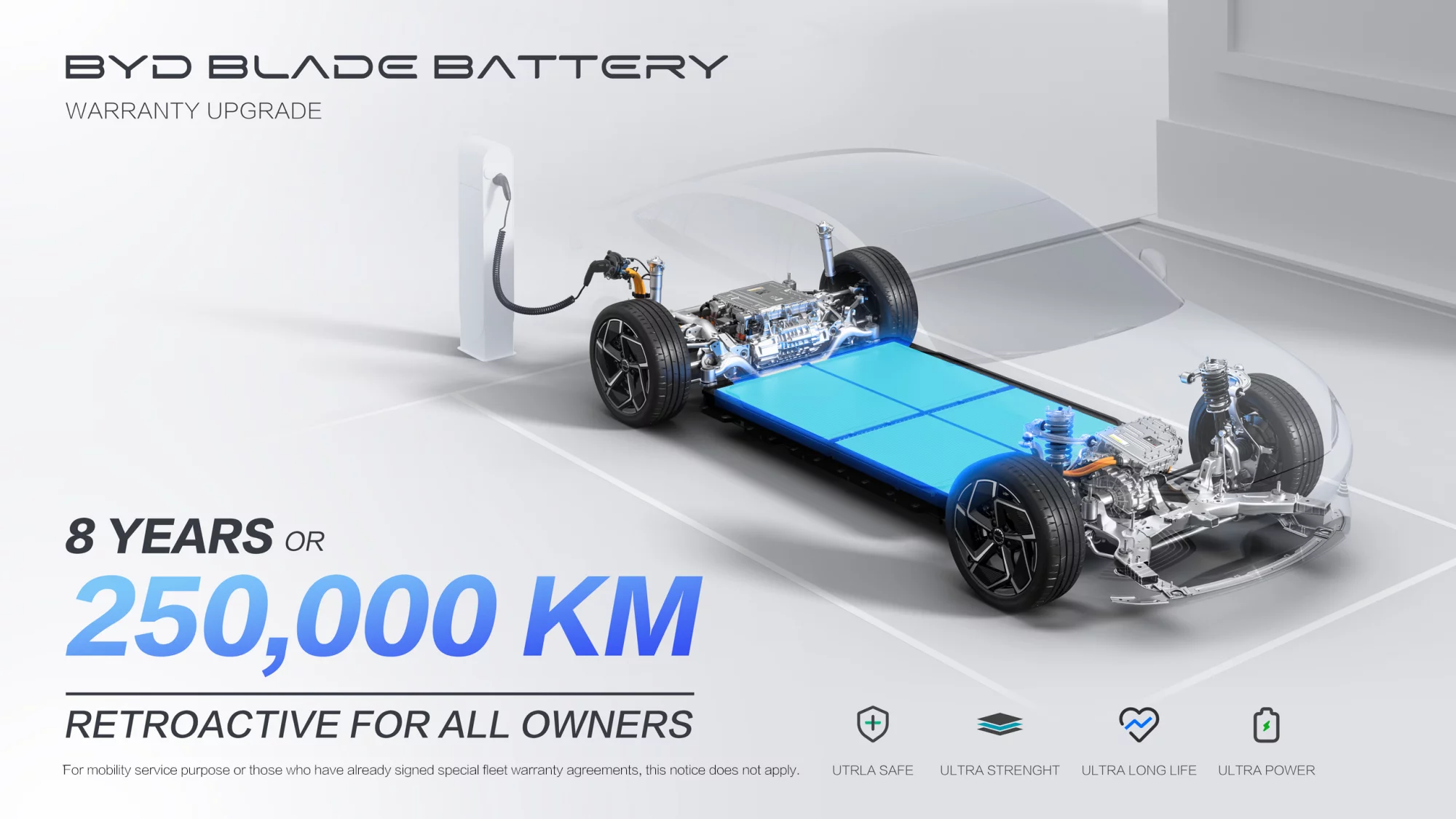

BYD has raised the mileage limit of its European Blade Battery warranty to 250,000 km while retaining the eight-year duration. The announcement also keeps the minimum battery State of Health threshold at 70 percent and extends the change to existing eligible cars as well as new vehicles.
The territorial scope is specific. BYD lists the European Economic Area, Switzerland and the United Kingdom, covering both its battery electric and Super Hybrid passenger cars. The release excludes vehicles used for mobility services, vehicles covered by individual fleet agreements and the ETP3. Those conditions define which owners can use the expanded cover described here.
For an eligible existing owner, the change is the higher mileage allowance under the battery policy. The announcement presents the extension as automatic. A warranty discussion still benefits from identifying the car's market, vehicle category and the applicable policy, particularly where fleet or commercial use is involved.
BYD also lists the other cover offered alongside the battery policy in this European announcement. These are a six-year or 150,000 km vehicle warranty, a twelve-year anti-perforation warranty without a mileage limit, and eight years or 150,000 km for the electric drive unit. The different limits are relevant when members describe which component a warranty question concerns.
Blade Battery uses lithium iron phosphate chemistry. BYD supports its durability claims with laboratory testing, including more than 3,000 charge and discharge cycles in its stated test programme. Those test results describe the manufacturer's development evidence, while the eight-year, 250,000 km and 70 percent State of Health terms define the battery cover announced for eligible European owners. The release's regional scope should remain attached to any summary shared with readers in the Americas.
Press photographs
Adapted by the BYDbase editorial team from the official BYD press release published 15 January 2026. Published on BYDbase by PTiCA. Photographs © BYD.
This article is filed under the original press-release date. Editorial adaptation and source check completed on 6 November 2026.
Recommended Comments