




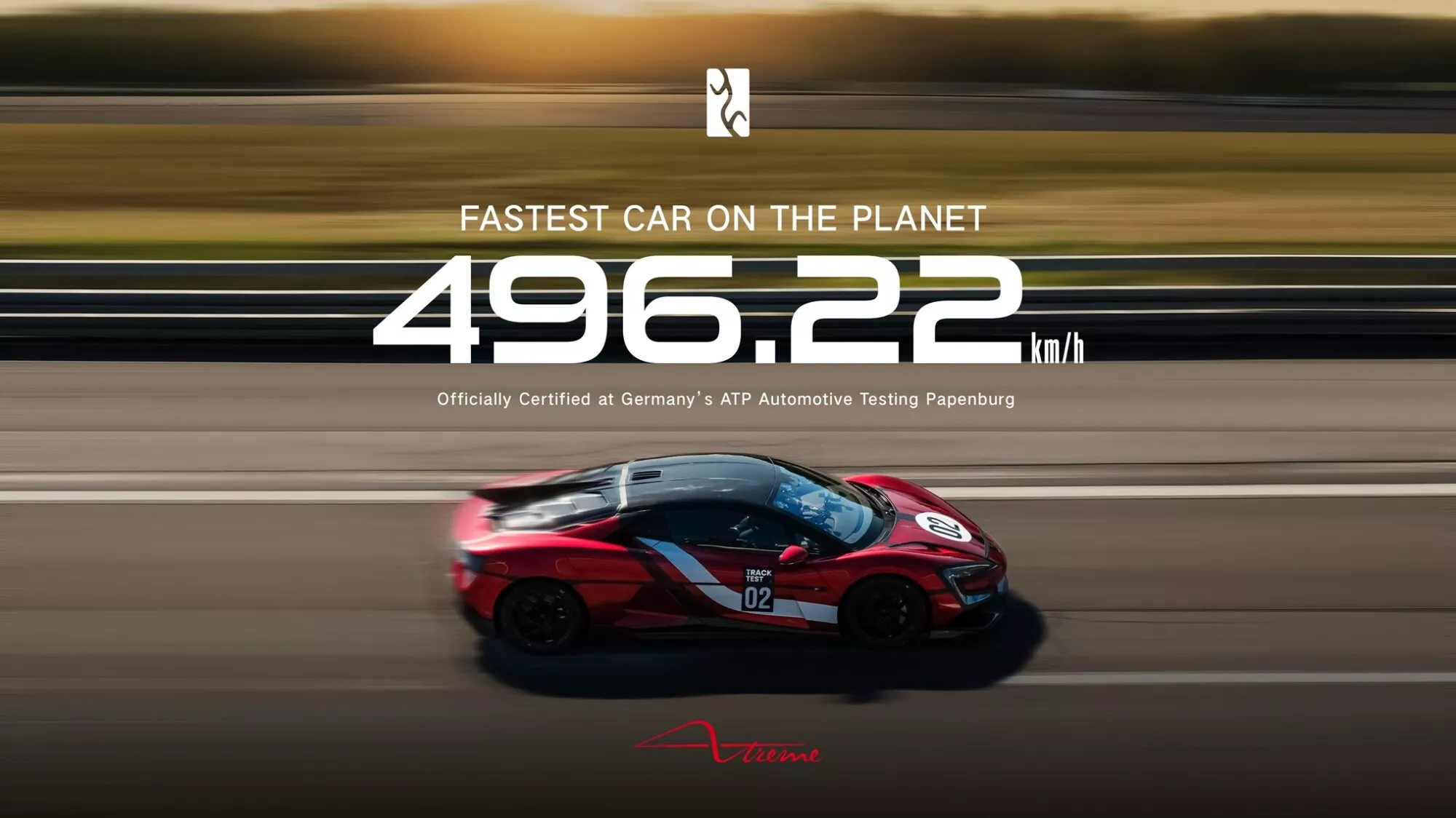

YANGWANG has announced that the U9 Xtreme reached 496.22 km/h at the ATP test track in Germany on 14 September 2025. Marc Basseng drove the car during the attempt. The manufacturer presents the result as a new production car speed record, exceeding its previous electric car benchmark.
The car previously described as the U9 Track or Special Edition now carries the U9 Xtreme production name, shortened to U9X. YANGWANG says it is being offered to customers in a series limited to a maximum of 30 examples, making the specification of that small production run central to the record claim.
Its electrical architecture operates at 1,200 V, compared with 800 V for the standard U9 described in the release. A lithium iron phosphate Blade Battery is specified with a 30C discharge capability. The four motors can turn at up to 30,000 rpm, with combined power exceeding 3,000 PS according to the manufacturer. The battery discharge rating concerns power delivery to the motors during demanding driving.
Other changes address the loads generated by track use. The U9X uses semi-slick tyres and a revised DiSus-X suspension configuration. These elements sit alongside the electrical and cooling developments needed to use the available motor output at very high speed.
The useful comparison for forum readers is between complete vehicle configurations and the way each test is conducted. This release reports a peak speed achieved at a specialist test facility by a professional driver. Details such as the production specification, tyres and measurement protocol belong alongside the headline figure when discussing records across different manufacturers. The U9X demonstrates how far BYD's luxury brand is taking its four-motor architecture in a very limited-volume application.
Press photographs
Adapted by the BYDbase editorial team from the official BYD press release published 20 September 2025. Published on BYDbase by PTiCA. Photographs © BYD.
This article is filed under the original press-release date. Editorial adaptation and source check completed on 6 November 2026.
Recommended Comments